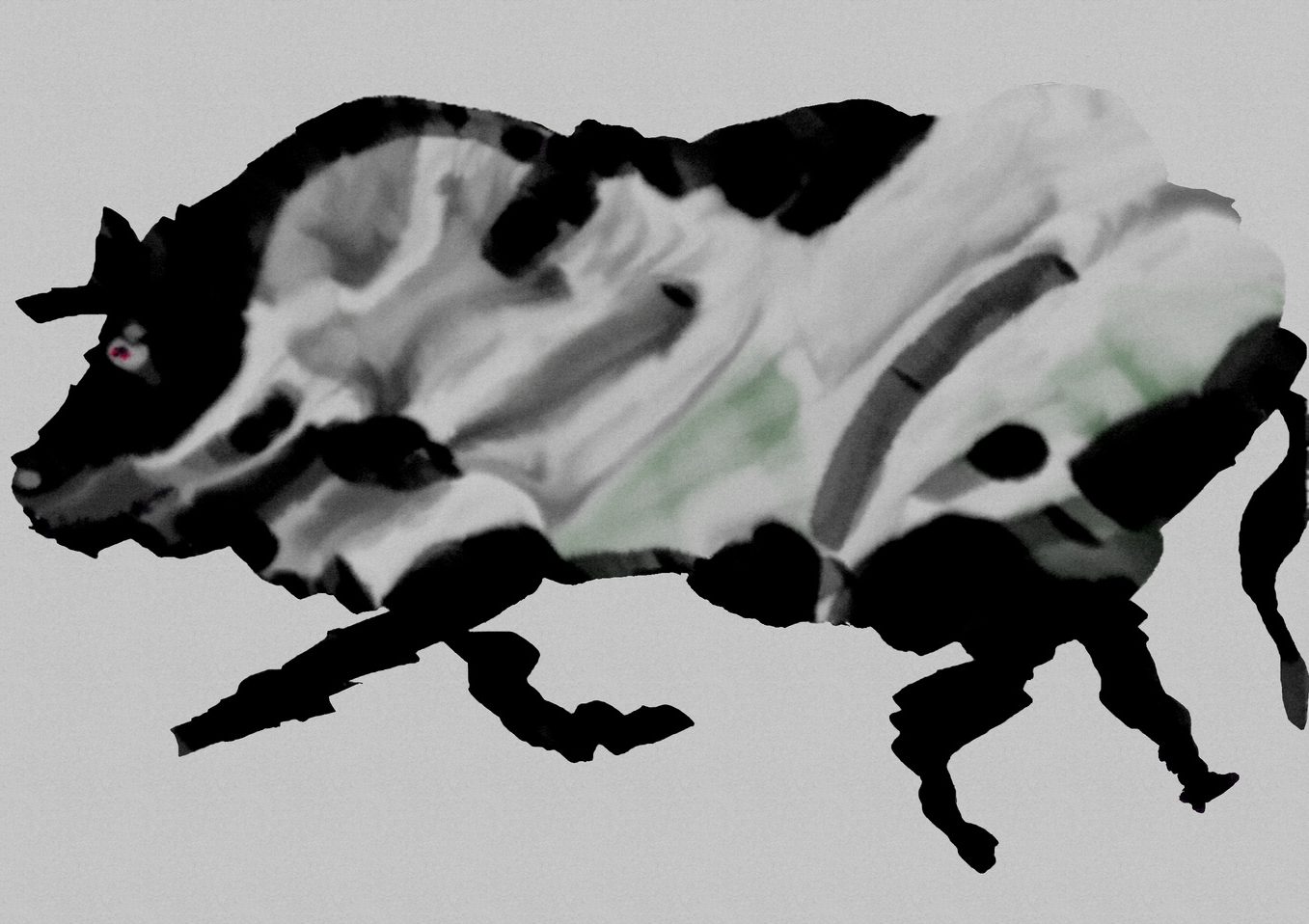
Reading Fahn C. Panz’s “Archimedes’ Screw”
Archimedes’ Screw

a been of ori-
gin vised method building temp-
oral time putting
“It’s just too hard to read.”
Utterance of an uninitiated
A been of ori- — thus we encounter a turn on emptiness, a disappearance into the past, reversing present, removal of the screws by breaking out into the air, paradoxically, leaving the aperture ajar, leaving it been as a receptacle emptied, or a hole unthreaded, needing what space cannot guarantee: time. Time — what else is reading out of space, or place; reading a screw, say, or askew like the sound of gin when poured out of the glass, the mechanics of bending the neck to let the head shadow the text, tipped slightly in vised position, a meditation on sight, the advent of light devised above the stationary lap — is it not the tap, the slit into which goes the beveled pen, or meaning, or method married to the lack of never having been? Once having been is never to experience the same ori- gin twice (after the cubes have melted), even once is never to repeat the same method, crossed-head or standard reservoir, the bit is not the lead, the crooked angle, rather that which affords hollowness in the event of turning round: the opposite of building (points), the undoing of temp-ori-(gin)al time in its putting inside the page, as one does into the mouth. The bit eats into something like the “I,” retrieves itself out of nothing, leaving behind a curvature, the landscape of been, the screw turned out from where it was, meaning both palette and time share an appetite for sign, or sight, or vised, meaning entrance is sort of cannibalistic, anthro-etymologically hungry, say. Or, is there a hint of sin, of gluttony in what language utters to itself, the illusion of itself, it being in the past tense of other than what it was. Can language lie? Can it have as method a dwelling place not left as hollow once removed? Does the spiral organ telling of where it came from leave us with less than of? Can one say that if the wood is hard, the page be blank, or just too hard to read? Hard, perhaps as a lollipop that needs sucking, slowly, reverentially patient the thing in question, reflecting on the arch of the movement, in and out like a feathery screw, displaced of time, user of space, and of talent recognized through the tongue — the taste of it, again, hard is reading in a stairwell winding sideways, darkened, ever tipsy, I closed.
Emile Gustave
 Umbriate Press Poetry